The Pressure to Be Well
From the team at Cherry Tree Counselling
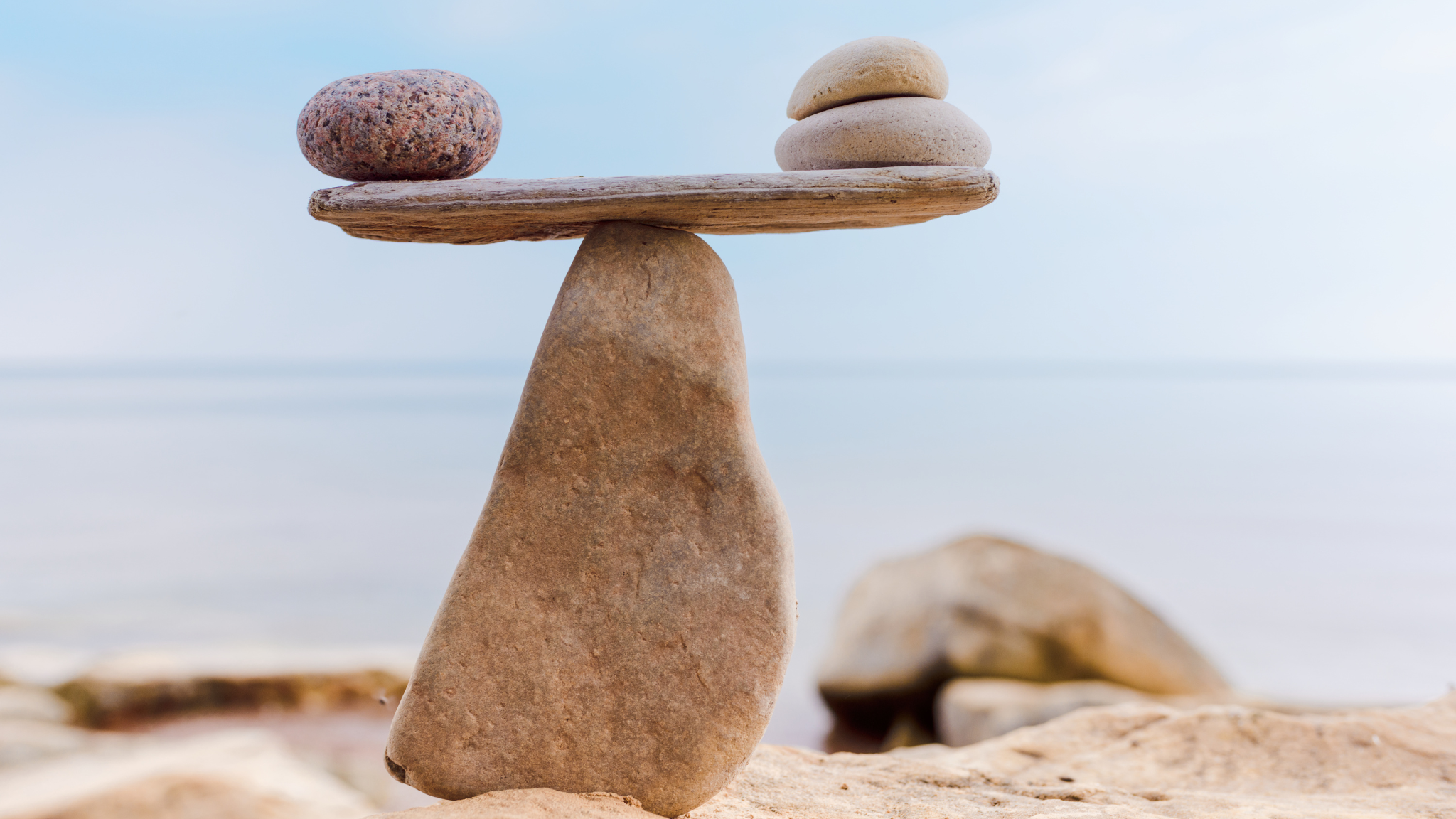
Caption: smooth stones are balancing on a flat thin rock on top of a taller, larger rock, symbolizing the delicate balance of navigating wellness.
Have you noticed how many “rules” there suddenly seem to be for good mental health?
Sleep eight hours. Set boundaries. Meditate daily. Journal. Get outside. Don’t scroll. Protect your nervous system.
We’ve been talking about how contradictory wellness culture feels right now. I asked our team to send me the “rules” they keep bumping up against in their own lives and in the therapy room.
The list came in quickly. Buckle up.
The wellness ones:
Say yes… but have airtight boundaries.
Feel your feelings… but regulate quickly.
Accept yourself as you are… but always be evolving.
Trust your intuition… but challenge your thoughts.
Don’t live in the past… but unpack and heal your trauma.
Be authentic… but don’t overshare.
Don’t bury your trauma…but don’t let it define you either.
Practice self-compassion… but hold yourself accountable.
Lower your expectations… but don’t settle.
Heal… but don’t take too long.
The achievement ones:
Rest and honour your capacity… but don’t fall behind.
Reject hustle culture… but hit your goals.
Stop multitasking….but don’t drop a ball.
Accept that everyone evolves in their own time… but make sure you’re always growing.
Get ahead… but don’t step on others.
Get more sleep… but excel in all areas of your life.
Work on your mindset… but also fix your circumstances.
Pursue balance… but maximize your potential.
The body ones:
Love your body… but make it better.
Age naturally… but don’t visibly age.
Be low-maintenance… but look polished.
Embrace body neutrality… but don’t “let yourself go.”
Stop obsessing over your appearance… but stay attractive and always be fit.
Decentre your looks… but be effortlessly beautiful.
Be confident in your postpartum body… but bounce back.
Do what makes you happy with your body… but make sure it’s for the “right” reasons.
“For a long time, we’ve been told we aren’t doing enough. Now there is a new layer: not being well enough.”
The sleep/career/domestic perfection/pressure ones:
Prioritize rest… but have a healthy dinner on the table and a thriving career.
Be a hands-on parent… but climb the ladder.
Protect your energy… but manage the household.
Raise emotionally intelligent kids… but also high achievers.
Have boundaries at work… but be indispensable.
Share the mental load… but keep everything running smoothly.
Ask for help… but don’t drop any balls.
The parenting ones:
Put yourself first… but be a fully present, hands-on parent.
Don’t pathologize your kids… but figure out what’s “wrong” early.
Don’t coddle your kids… but build secure attachment.
Break generational cycles… but don’t mess them up in new ways.
Validate their feelings… but don’t let them run the house.
Be honest with your kids and show emotion…but don’t put your stuff onto them.
Let them fail… but make sure they are successful.
Encourage independence… but be aware of risky behaviours.
Limit screens… but make sure they fit in.
The gendered ones:
Challenge patriarchy… but stay likable.
Be a feminist… but don’t make people uncomfortable.
Take up space… but not too much space.
Be ambitious… but not intimidating.
Be strong… but soft.
Have boundaries at work… but be indispensable.
Prioritize your career… but manage the household.
If this list feels overwhelming, that’s the point.
For a long time, we’ve been told we aren’t doing enough. Now there is a new layer: not being well enough. We cannot just struggle. We have to struggle correctly.
No matter how much we read, how much we practice, how many podcasts we download, how many morning routines we attempt, or how much money we shell out for self-help, it never quite feels like enough. There is always another layer to optimize. Another blind spot to uncover. Another habit to fix. Wellness starts to feel like something you are constantly scrambling toward, just out of reach.
What we see, over and over again, is not a lack of effort.
It is the weight of trying to be well in the “right” way. There is pressure to be self-aware but not self-absorbed. Empowered but not intimidating. Healing but not messy. Politically conscious but emotionally regulated.
Wanting to grow, to heal, to do better — that is deeply human. The problem is not striving. The problem is the belief that we must constantly optimize ourselves in order to be worthy. Soft but resilient.
Growth is not the enemy.
Perfectionism and relentless pressure are.
We are not just trying to get through hard things. We are trying to get through them in a way that looks evolved.
That is a heavy lift for any nervous system.
The Systemic Lens We Cannot Ignore
There is another layer to this that we talk about often as clinicians.
We are asking individuals to be exceptionally well inside systems that are profoundly unwell.
Housing is precarious. Wages are stretched. Childcare is expensive. Healthcare systems are overwhelmed. Social media amplifies outrage and comparison. Many of us are carrying debt, caregiving responsibilities, climate anxiety, and a constant undercurrent of uncertainty. In Canada, there is a real anxiety about our sovereignty and about the political volatility south of the border. The world feels less stable than it once did. Even when we try to focus on our own small lives, global tension leaks in. Our bodies absorb it.
We are living with instability — economically, politically, environmentally. There is a collective anxiety in the air, even when we try to stay positive.
Yet the message we receive is deeply individualistic: regulate better. Think more positively. Set firmer boundaries. Fix your mindset. Put yourself first.
Personal responsibility matters. Coping skills matter. Insight matters.
But systems matter too.
It is difficult to thrive in structures that exhaust you. It is hard to cultivate deep rest when survival feels shaky. It is nearly impossible to feel consistently “well” when so many people around you are struggling to access basic needs.
It’s too easy to internalize systemic strain as personal inadequacy.
When we widen the lens, the question shifts from “What is wrong with me?” to “What are we living inside of?”
There is something profoundly human about recognizing that wellness is not only individual. We are wired for connection, for mutual care, for shared responsibility. Collective cultures have long understood that well-being is relational, not just personal. There is wisdom in the idea that we do better when we take care of each other, when resources are shared more equitably, when rest and safety are not luxuries.
It is hard to be the only regulated person in a burning building.
Keeping our humanity in systems that reward overwork, competition, and endless self-improvement is a quiet act of resistance. Choosing compassion over comparison. Community over isolation. Enoughness over constant optimization.
The Body Is Not a Self-Improvement Project
When we started talking about contradictions, the body-based ones came up immediately.
There is a quiet cruelty in this. Especially for women and for people whose bodies have always been commented on, regulated, judged, or politicized. Many of us were raised to believe that we were either too much or not enough. Now the bar has shifted again. Not only must you be enough… you must be well enough.
You cannot simply struggle. You must struggle mindfully. You must struggle in a way that demonstrates growth.
All of this is unfolding against a backdrop of very real stress.
Of course we are tired.
Of course our concentration wavers.
Of course our moods dip.
Of course there is a low hum of existential dread some days.
This is not weakness. It is context.
When Everything Becomes Pathology
As clinicians, we deeply believe in the value of accurate diagnosis and supportive treatment. Naming a pattern can be relieving. Medication can be life-saving. Therapy can be transformative.
At the same time, we are aware of how quickly (and sometimes carelessly) ordinary human responses are being folded into pathology. Not every distraction is ADHD. Not every season of sadness is a disorder. Not every bout of exhaustion is a personal failure that needs optimizing.
Sometimes you are depleted because you are carrying too much.
Sometimes you are anxious because there is real uncertainty around you.
Sometimes, you are discouraged because the systems we live within are grinding us down.
If we rush to pathologize every discomfort, we risk sending the message that if you were coping better, regulating better, thinking better, you would not feel this way.
That message can land like shame.
Trusting Yourself in a Noisy World
One contradiction that really stood out in our conversation was this one: trust your intuition… but challenge your thoughts.
Both matter. Neither is simple.
Your intuition is often your body’s accumulated wisdom. It recognizes patterns and signals safety or misalignment quickly.
Your anxious thoughts are shaped by lived experience and by the broader climate you are living in. When the world feels unstable, hypervigilance makes sense.
Discernment requires relationship with yourself. It requires knowing what anxiety feels like in your body versus what clarity feels like. It requires slowing down long enough to notice the difference.
There is no perfect formula.
There is practice. There is self-compassion. There is community.
The Goal Is Not to Be Happy All the Time
Mental health has quietly become synonymous with constant positivity and upward growth.
In our work, we see something much more grounded.
Wellness might look like relative steadiness. The ability to access calm some of the time. The capacity to feel joy without demanding it daily. The resilience to move through grief without assuming you are broken.
There’s a teaching in Buddhism that the root of much suffering is attachment — not just to people or things, but to expectations. The expectation that we should be happier than this. More regulated than this. Further along than this.
Lowering expectations does not mean settling or giving up on growth. It means loosening the grip on the fantasy that life should feel better than it does right now. It means accepting that being human includes discomfort, disappointment, boredom, uncertainty.
When our expectation is constant happiness, anything less feels like failure. When we expect that life will include difficulty, ordinary contentment starts to feel like enough.
Maybe part of the work is not constantly raising the bar for ourselves, but gently lowering it. Not in ambition, but in emotional perfection. Not in care, but in pressure.
We can care deeply about the state of the world and still need rest. We can want systemic change and also protect our own capacity. We can be functioning and still unsettled.
From all of us here at Cherry Tree, this is what we want you to hear:
If you feel like you are constantly chasing wellness and never quite arriving, it’s not because you are failing.
It is because you are a human being trying to live well inside systems that make that very hard.
Staying connected to ourselves and to each other, protecting our capacity, and refusing to turn our pain into a personal defect may be some of the most radical things we can do.
In a culture that keeps raising the bar, keeping our humanity intact is enough.
If you’re feeling the weight of all of this, we’re here to listen and to walk alongside as you figure out what wellness actually means for you.
Feel like yourself again.
Whether you're facing a current challenge, a past pain, or are simply feeling stuck in this phase of your life, we can help you to live the life you want with intention, mindfulness and balance.
We are accepting new clients and offer free consultations.

